Color fading or transfer ruins product reputation, and you need reliable testing to guide formulation and quality control. A weak dye choice can release color during washing, rubbing, or sunlight exposure. To select the right Color Fastness Testing Machines, you must define your testing needs based on material and standards, understand test types such as wash, light, and rub, evaluate specifications like manual versus automatic operation, weigh budget against return on investment, check compliance, and assess vendor support. This guide helps lab managers and technicians make an informed decision. You will ensure accuracy, efficiency, and compliance in every test your laboratory performs.
Key Takeaways
-
Define your testing needs by material and standards first.
-
Understand rubbing, washing, and light test methods.
-
Compare manual and automatic machines for your lab.
-
Weigh budget against long-term value and compliance.
-
Choose a vendor with certified equipment and strong support.
Identify Testing Needs for Color Fastness Testing Machines
Match Materials to Machines
Your material type and product category dictate the test method and machine capabilities you need. A denim mill faces different demands than a home textile supplier. Denim, heavily dyed jerseys, and dark-colored fabrics are the most common categories where crocking failures occur. For these materials, you need a Crockmeter Rubbing Fastness Tester that handles both dry and wet conditions. Wet crocking is almost always the more demanding of the two.
Consider your product's end use. Sportswear and outdoor furniture face prolonged sunlight exposure, so they demand higher performance standards. Indoor items like upholstery and drapery need testing under less severe conditions. A Washing Colorfastness Tester suits apparel fabrics, home textiles, and dyed yarns. This machine measures color change, staining of adjacent fabrics, and dye bleeding.
Align with Industry Standards
Standards define critical test conditions so results remain comparable across laboratories. Key standards include ISO 105 for color fastness, ISO 139 for conditioning, ISO 6330 for domestic washing and drying, and AATCC standards. These documents specify test cloth type, pressure, number of cycles, and assessment criteria.
Environmental elements including light exposure, humidity levels and chemical exposure can impact the durability of color in textiles. Direct sunlight exposure often leads to fading in various dye types.
Select your test method according to exposure conditions. The table below maps common scenarios to suitable light sources.
|
Exposure Condition
|
Light Source / Test Consideration
|
Performance Requirement / Application
|
|
Outdoor exposure
|
Carbon arc lamps (high intensity)
|
Suitable for outdoor fabrics requiring rigorous light fastness testing
|
|
Artificial lighting exposure
|
Fluorescent UV lamps
|
Used for materials likely exposed to artificial lighting
|
|
Natural sunlight simulation
|
Xenon arc lamp
|
Closely simulates natural sunlight; provides consistent, reproducible testing with controlled light, heat, and humidity
|
|
Outdoor end-use (e.g., sportswear, outdoor furniture)
|
More rigorous testing required
|
Prolonged sunlight exposure demands higher performance standards
|
|
Indoor end-use (e.g., upholstery, drapery)
|
Testing under different conditions
|
Reflects typical indoor usage environment with less severe light exposure
|
Deeper shades tend to have better fastness properties. However, a deep dyeing with poor wash fastness will release more dye. This affects your formulation decisions. A Manual AATCC Rotary Vertical Crockmeter helps you evaluate these trade-offs before committing to production.
Types of Color Fastness Testing Machines
Rubbing, Washing, and Light
Rubbing fastness testing measures how much color transfers from a dyed sample onto a white cloth. You clamp the colored specimen onto the machine base, then a mechanical finger wrapped in standardized white cotton moves back and forth under about 9 N of pressure. You run the test twice, once dry and once wet, then grade the white cloth on a gray scale from 5 (no visible staining) down to 1 (significant color transfer). A Crockmeter Rubbing Fastness Tester handles this work in manual, digital, and rotary configurations. The two dominant standards differ mainly in moisture. AATCC 8 uses roughly 65 ± 5% wet pickup, while ISO 105 X12 requires about 100%. That gap matters: a fabric scoring an acceptable Grade 4 under AATCC rules can fall to a failing Grade 2 under the wetter ISO method. AATCC 8 typically runs 10 rubs at 1 rub per second, while some ISO 105-X12 setups use 150–200 rubs.
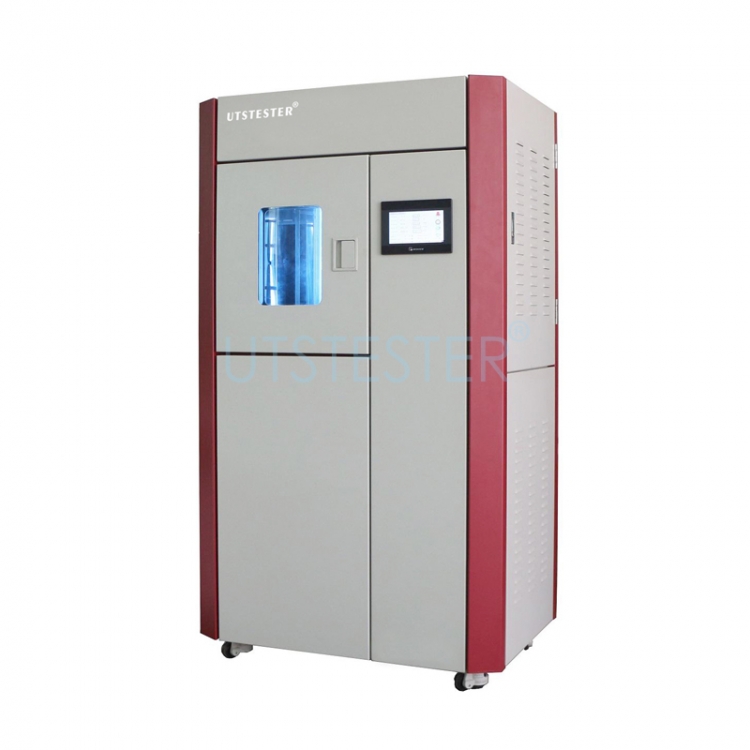
Washing fastness testing evaluates color change and staining after controlled laundering or dry cleaning. A Washing Colorfastness Tester such as the GT-D07 supports ISO 105-C06 and AATCC 61 through different washing cup configurations, liquor ratios, and detergent formulations. The instrument holds a constant rotation speed and precise temperature, so every specimen receives uniform mechanical action. Digital washing fastness testers, also called Laundrometers, come in several configurations, including 8 × 550 ml beakers, 4 × 550 ml plus 4 × 1200 ml beakers, and 8 × 550 ml plus 8 × 1200 ml beakers. They use a stainless steel bath, programmable digital temperature control, a PT-100 sensor, and roughly 40 ± 2 RPM rotation on single-phase 220 V AC supply.
Light fastness testing matters because color durability is a key indicator of textile quality. Testers divide into three groups by light source: xenon arc lamps, carbon arc lamps, and fluorescent lamps. Xenon arc lamps closely simulate natural sunlight and deliver consistent, reproducible results with controlled light, heat, and humidity. Carbon arc lamps suit outdoor fabrics that need rigorous exposure testing. Fluorescent UV lamps serve materials likely exposed to artificial lighting. A Manual AATCC Rotary Vertical Crockmeter complements this work by letting you check crocking performance alongside light exposure results.
Specialized Industry Tests
Different industries add their own requirements on top of the core three tests. The garment industry combines color fastness with dimensional stability, tensile strength, and abrasion resistance. Acceptance criteria are strict: Grade 4 or better for washing, light, and perspiration fastness, Grade 4 dry and Grade 3 wet for rubbing, and shrinkage limits of 3–5% for most adult apparel and 1–2% for fitted items. Denim fabrics demand crocking, shrinkage, tensile strength, tear strength, abrasion resistance, and shade consistency. Activewear focuses on stretch, recovery, moisture management, and perspiration fastness. Workwear needs high strength, abrasion resistance, and wash durability. Automotive interiors rely on xenon arc light fastness testers, perspiration testers, and digital color assessment cabinets. Leather goods use crocking testers, perspiration testers, and light fastness instruments.
Home textiles and upholstery combine light fastness testers, wash fastness testers, and digital color assessment cabinets. These Color Fastness Testing Machines cover perspiration and sea water testing through perspirometers, sunlight through MBTL light fastness testers, and hot pressing through sublimation testers. Matching the machine to your industry segment keeps every result comparable and defensible.
Evaluate Color Fastness Testing Machines
Key Specifications
You need a clear comparison framework before you invest. Start with the parameters that directly affect test validity. A Washing Colorfastness Tester should hold temperature within ±2°C across a 0–95°C range. Rotation speed must stay at 40±2 rpm. Heating rate should reach 1.5±0.5°C/min. These tolerances determine whether your results remain defensible during audits.
|
Parameter
|
Specification
|
|
Power
|
220V/3N/50–60Hz (40A) or 380V/3N/50–60Hz (23A)
|
|
Weight
|
150 kg
|
|
Dimensions (L×W×H)
|
1060 × 720 × 860 mm
|
|
Temperature Range
|
0–95°C (±2°C)
|
|
Heating Rate
|
1.5±0.5°C/min
|
|
Rotation Speed
|
40±2 rpm
|
|
Cup-to-Axis Distance
|
45±10 mm
|
|
Compliance Standards
|
ISO 105-C06/C08/C09/C10, E03/E12; AATCC 61, 132, 190; GB/T 12490, 29255, 3921; M&S C4A, NEXT TM 02
|
|
Test Steel Cups
|
12 pcs, 550±50mL or 1200±50mL
|
|
Stainless Steel Balls
|
200 pcs, Φ6±0.5mm
|
Standards coverage drives your purchase decision. A machine that complies with ISO 105-C06, AATCC 61, and GB/T 12490 covers most textile markets. Optional standards like ISO 105-D01 add dry cleaning capability. Method coverage and calibration support influence supplier pricing. Traceable methods and proficiency testing programs reinforce the need for reliable calibration services. Buyer confidence rises when you can defend test conditions during brand audits and shipment disputes.
Capacity matters for throughput. Twelve steel cups at 550±50mL or 1200±50mL let you run multiple specimens simultaneously. Stainless steel balls at Φ6±0.5mm provide consistent mechanical action. Sampling plates in three sizes accommodate different fabric dimensions. A Crockmeter Rubbing Fastness Tester complements this setup for crocking evaluations.
Automation in Industrial Labs
Manual testers demand constant operator attention. You handle sample mounting, liquid addition, timing, and result recording by hand. Human error creeps into every step. Temperature variation runs high. Test results get written on paper. Operator dependence stays high.
|
Dimension
|
Manual Testers
|
Automatic Testers
|
|
Accuracy
|
Lower; human error and subjective judgment cause inconsistency
|
Higher; standard operating procedures control parameters
|
|
Repeatability
|
Lower; operator-dependent variations create inconsistencies
|
Reliable; automated control reduces variation
|
|
Operational Efficiency
|
Slower; manual tasks delay reporting and raise labor costs
|
Greater; automation speeds up processes and cuts errors
|
Automatic Color Fastness Testing Machines cost more upfront. They deliver better results and require less manual work. The Wash True smart washing fastness tester automates soap weighing, water dosing, heating, and stirring. It prepares samples in minutes. Three independent tanks allow simultaneous preparation of multiple soaps. This increases daily test throughput. Automatic heating, stirring, and steel ball dispensing eliminate human error and test-to-test variation. High-accuracy dosing ensures correct soap weight and bath proportions each time. A closed system prevents contamination and handling of soap flakes. Wi-Fi connectivity to SmarTexLab App and ERP/LIMS enhances lab data management.
Modern testers reduce variation to approximately ±2°C temperature and 40±2 r/min rotation. Built-in automatic feed testing programs align closely with AATCC and ISO standards. Integration with ERP and LIMS enables real-time monitoring and digital result generation. This reduces human errors and variation significantly.
Digital grading systems take automation further. DigiGrade automatically grades color fastness test samples. It offers high efficiency and accuracy. You eliminate subjective visual judgment. The system provides consistent, repeatable assessments across your entire operation.
A Manual AATCC Rotary Vertical Crockmeter still serves specific needs. It suits smaller labs with lower throughput requirements. It also works well for training purposes. But for industrial laboratories processing high volumes, automation delivers measurable ROI through labor savings and improved accuracy.
Choose your automation level based on your testing volume and quality requirements. High-volume labs benefit most from fully automatic systems. Smaller operations may find manual equipment sufficient. The key is matching machine capability to your actual workflow demands.
Budget and Compliance
Balancing Cost and Value
You face a real tension between limited budgets and the need for reliable, standards-compliant equipment. Testing cost typically runs 0.5–2.0% of sales. Quality failures cost far more: 5–20% of sales through rework, returns, and reputation damage. That gap explains why the cheapest machine often becomes the most expensive choice.
Automatic testers carry a higher upfront price. They pay you back through labor savings and fewer errors. Consider the numbers below.
|
Technology
|
Labor Cost Impact
|
Error/Consistency Impact
|
|
Automated Testing
|
Long-term -15%
|
Consistency +30%
|
|
Digital Color Matching
|
-25% labor costs
|
Accuracy +40%
|
|
AI Quality Prediction
|
Savings +25%
|
Defect detection +60%
|
A break-even analysis compares testing costs against failure prevention benefits. You maximize prevention while minimizing appraisal costs. Four benefits drive this return:
-
Quality Control: Regular testing identifies color fastness issues early, reducing waste and rework.
-
Cost Savings: Preventing color bleeding and transfer avoids returns, complaints, and non-compliance penalties.
-
Brand Reputation: Consistently high-quality products build loyalty and reduce revenue loss from returns.
-
Compliance: Meeting ISO and AATCC standards protects you from shipment rejections and audit failures.
Trusted equipment pays for itself over time. With strong support, certified documentation, and consistent performance, you avoid hidden costs from repairs, downtime, or retesting. This results in increased uptime, more precise results, and more efficient use of your budget annually.
Certifications and Vendor Support
Certifications and compliance with ISO and AATCC standards are non-negotiable for industrial laboratories. A machine without proper certification produces results that brands and auditors will reject. You need documented calibration, traceable test conditions, and proof that your Color Fastness Testing Machines meet the standards your buyers require.
Vendor support determines your long-term ROI and uptime. UTS International provides certified equipment with robust support and maintenance services. Their pre-delivery process calibrates and debugs every testing device before shipment. Their after-sales team resolves issues within 24 hours, 7 days a week, via email or video. Full telephone engineering support is available 24 hours a day, 365 days a year. You receive an English operation manual and operation video. On-site machine training and installation are available for a fee, and you may visit the factory for inspection and training. A 12-month warranty covers product problems, with free spare parts provided (excluding consumables and man-made damage). This support structure minimizes downtime and keeps your lab running efficiently.
Define your testing needs by material and standards first. Understand rubbing, washing, and light test methods. Compare manual versus automatic specifications. Weigh budget against long-term value. Verify certifications and vendor support before purchase.
The right Color Fastness Testing Machines align with your laboratory's workflow. You achieve accurate, repeatable results. You reduce errors and downtime. You protect your brand reputation through consistent quality.
Choose a vendor with certified equipment and robust after-sales service. UTS International provides calibration, training, and 24/7 support. Their machines meet ISO and AATCC standards. This partnership ensures long-term efficiency and compliance.
FAQ
Which standard should you follow for rubbing fastness testing?
Your choice depends on your buyer's market. AATCC 8 uses roughly 65 ± 5% wet pickup, while ISO 105 X12 requires about 100%. That difference matters. A fabric passing under AATCC rules can fail under the wetter ISO method. A Crockmeter Rubbing Fastness Tester handles both, so confirm your target standard before you buy.
How do you decide between manual and automatic testers?
Match the machine to your testing volume. Manual units suit smaller labs and training work. High-volume industrial labs gain more from automation. A Washing Colorfastness Tester with automated soap weighing, water dosing, and stirring cuts human error and raises daily throughput. Weigh the higher upfront cost against long-term labor savings.
Which light source fits your light fastness testing?
It depends on your product's exposure conditions. Xenon arc lamps closely simulate natural sunlight and give reproducible results with controlled light, heat, and humidity. Carbon arc lamps suit outdoor fabrics needing rigorous exposure. Fluorescent UV lamps serve materials exposed to artificial lighting. A Manual AATCC Rotary Vertical Crockmeter complements this work for crocking checks.
What support should you expect after purchase?
Look for certified equipment, documented calibration, and responsive service. UTS International calibrates and debugs every device before shipment. Their team resolves issues within 24 hours, seven days a week, and offers full telephone support 24/7/365. A 12-month warranty covers product problems, with free spare parts excluding consumables and man-made damage.


 +86 152 6060 5085
 English
 русский
 español
 português
 العربية
 Polski


 hello@utstesters.com
 hello@utstesters.com
 +86 152 6060 5085
 +8615260605085