The right flammability test equipment depends on three things: your material, the applicable standard, and the required test method. You cannot pick a tester before you know these details. A plastic component and a textile demand different fire and flammability setups, and each standard defines its own procedure.
This article covers equipment types, key features, and a matching framework for QA engineers, lab technicians, and procurement specialists. Choose flammability testing equipment with care. Compliance, accuracy, and safety all rest on that decision. A wrong choice wastes budget, fails audits, and puts people at risk.
Key Takeaways
-
Choose equipment based on your material, the standard, and the test method.
-
Vertical tests check afterflame and dripping; horizontal tests measure flame spread.
-
Key features include ignition control, chamber design, data logging, calibration, and safety interlocks.
-
Follow a step-by-step framework: identify material, confirm standard, choose method, select equipment.
-
Partner with a supplier like UTS International for compliance support and training.
Types of Flammability Test Equipment
You can organize flammability test equipment by test orientation: vertical, horizontal, greater than 45 degrees, and less than 45 degrees. Each orientation answers a different question about how a material behaves when a flame ignition source touches it. Vertical setups expose a specimen to flame from below and reveal whether drips ignite cotton below. Horizontal setups measure how fast a flame travels along a flat surface. Angled configurations between these extremes simulate real-world mounting conditions, such as sloped panels or tilted components.
UL 94 dominates horizontal and vertical flammability testing of electrical equipment and plastic components. The standard defines several classifications you will encounter when you compare flammability testing equipment. Horizontal Burn Test (HB) covers slow-burning materials. Vertical Burn Tests include V-0, V-1, and V-2, ranked by afterflame time and whether flaming drips ignite cotton. Other standards serve specific industries: ASTM E84 for building materials, FMVSS 302 for automotive interiors, and NFPA 701 for curtains and draperies. These examples show how the applicable standard shapes the equipment you need.
Types of Fire and Flammability Testing by Material
The material under test drives the method. For plastics, UL 94's 94HB test holds a specimen horizontally and applies flame for 30 seconds or until the flame front reaches the 1-inch mark. Burning rate is measured between the 1-inch and 5-inch marks. For thickness below 0.118 inch, the burning rate must stay under 3 inches per minute to pass. The 94V test holds the specimen vertically and applies flame for two 10-second intervals. V-0 requires afterflame of 10 seconds or less per specimen, a total of 50 seconds or less, and afterglow of 30 seconds or less. V-1 allows afterflame up to 30 seconds per specimen and a total up to 250 seconds. V-2 shares V-1's afterflame limits but permits flaming drips that ignite cotton. Thin materials use 94VTM, where an 8-inch by 2-inch specimen is rolled around a half-inch mandrel and flame is applied for 3 seconds.
Building materials follow ASTM E84, the Steiner Tunnel Test. A sample is installed in a tunnel 24 feet long and 1.8 feet wide, with air moving at 240 feet per minute. Evaluators measure how quickly flames spread and how much smoke develops, then assign a Flame Spread Index.
|
Classification
|
Flame Spread Index
|
|
Class A
|
0-25
|
|
Class B
|
26-75
|
|
Class C
|
76-200
|
Textiles use NFPA 701, which evaluates response to small-scale flames, while ASTM E84 covers wall coverings, flooring, and finishes. Automotive interiors follow FMVSS 302, where a horizontally mounted specimen meets a Bunsen burner flame for 15 seconds and must not exceed a burn rate of 102 mm per minute.
Foam Horizontal Burning Tester and Other Method-Based Equipment
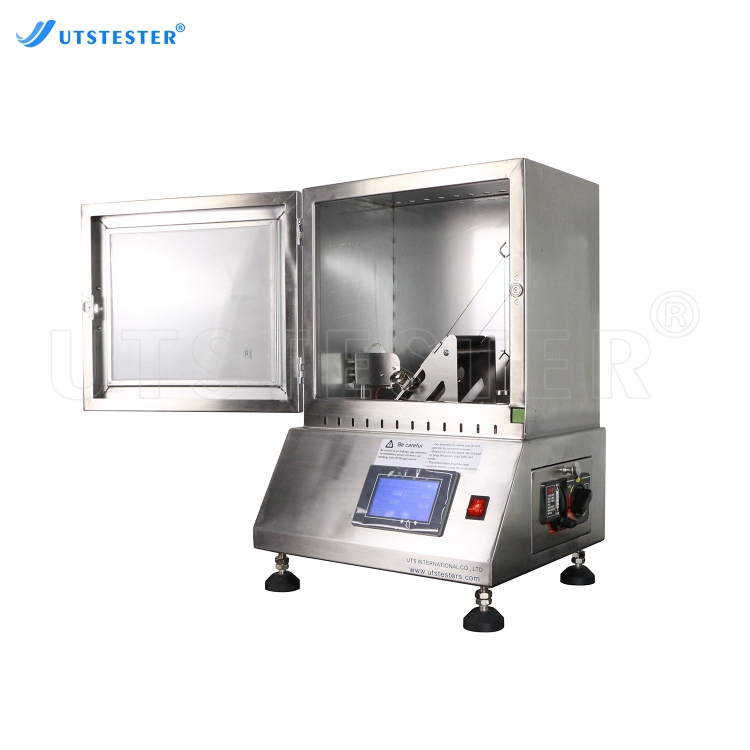
A foam horizontal burning tester applies UL 94's Horizontal Burn Foam (HBF) method to non-structural foam components. Specimens measure 150 ±5 mm by 50 ±1 mm, tested at minimum and maximum thicknesses up to 13.0 mm. You prepare two sample sets: as-received, conditioned 48 hours at 23°C and 50% humidity, and heat-aged, conditioned 168 hours at 70°C. A Bunsen burner with a wing tip ignites the foam horizontally for 60 seconds, and you record the time for the flame to travel from the 25 mm mark to the 125 mm mark. After 2023, materials with density of 250 kg/m³ or higher may no longer qualify for HBF and instead fall under the HB classification. A foam horizontal burning tester pairs with related methods such as D3675, E162, and E662 for surface flammability and smoke density. A foam horizontal burning tester also supports comparative screening across foam grades. When you select a foam horizontal burning tester, confirm it accommodates your thickness range. A foam horizontal burning tester with proper fixturing reduces operator variability. Many labs pair a foam horizontal burning tester with a vertical flammability chamber to cover both orientations. An automatic flammability tester can run a foam horizontal burning tester cycle with repeatable timing. Your foam horizontal burning tester should log burn time and distance automatically.
Key Features to Consider
Fire and Flammability Testing Parameters
Every fire and flammability testing setup measures a defined set of physical quantities. You track temperature, heat flux, mass loss rate during burning, pressure, velocity, flow, and smoke density. Light sensors handle the smoke density piece. Different testers evaluate different outcomes: ignition, flame spread, heat release, and fire resistance. Your material and standard decide which parameters matter most.
Fire and flammability testing for lithium-ion battery testing adds electrical and thermal runaway measurements to the list. Fire and flammability testing for textiles focuses on flame spread testing along the fabric surface. Fire and flammability testing for foam relies on a foam horizontal burning tester to log burn time and distance. Each branch of fire and flammability testing demands its own sensor package.
The relationship between mass loss and heat release deserves attention. ASTM E1354 cone calorimeter work ties them together directly:
The effective heat of combustion is determined from a concomitant measurement of specimen mass loss rate, in combination with the heat release rate.
That link matters for reaction to fire analysis. A material can lose mass quickly without releasing much heat, or release heat while barely losing mass. You need both channels to judge performance.
Smoke density measurement follows its own logic. For ASTM E662 smoke density testing, the optical sensor employed is a photomultiplier tube, which captures slight changes in flue gas content within the test chamber. The procedure runs in sequence:
-
The sample is exposed to heat and/or flame for a specified duration (typically 4 or 20 minutes).
-
A photometric system records light transmittance values to determine optical density.
-
Smoke is collected in a chamber, and a light beam passes through it.
-
The photometric system measures how much light is attenuated by the smoke.
-
The system collects and calculates data, with the smoke density rating derived from light absorption versus time.
Data Recording, Calibration, and Safety Systems
Five features separate a reliable tester from a marginal one. Ignition source control tops the list. You need repeatable flame ignition timing, gas flow, and burner position. Flame ignition testing lives or dies on that repeatability. Chamber design comes next. A standardized test chamber design controls airflow, exhaust, and specimen mounting so results stay comparable across labs. Data recording captures combustion and self-extinguishing periods, temperature curves, and smoke readings without manual transcription errors. An automatic flammability tester handles this logging for you. Calibration keeps sensors honest over time. Safety interlocks protect operators from burns, fumes, and unexpected flare-ups.
Fire resistance testing adds its own demands. You measure how long a barrier holds back fire under load, so the rig needs structural support and thermal monitoring together. A vertical flammability chamber often serves both fire resistance and vertical burn work. Fire testing labs pair it with horizontal rigs to cover every orientation. Compliance depends on these features working together. Safety compliance depends on them too. When you compare flammability test equipment, check ignition control, chamber design, data logging, calibration schedules, and interlocks before you look at anything else. Those five features protect accuracy, compliance, and the people running the test.
How to Match Flammability Test Equipment to Your Needs
A Step-by-Step Selection Framework
You need a repeatable process to match flammability test equipment to your application. Follow these steps in order.
-
Identify your material. Plastics, textiles, foam, and building products each demand different fixturing and specimen preparation.
-
Confirm the applicable standard. Your industry, intended end user, and production methods narrow the list. Automotive interiors point to FMVSS 302. Electrical components point to UL 94. Building materials point to ASTM E84.
-
Choose the test method. Vertical, horizontal, or angled orientation follows from the standard. A vertical flammability chamber suits V-0, V-1, and V-2 work. A horizontal rig suits HB and HBF methods.
-
Select the equipment. Match chamber size, ignition control, and data logging to your test specifications.
Your industry shapes every choice. A medical device maker faces different compliance demands than a furniture manufacturer. The intended end user matters too. A product bound for a data center must meet stricter fire and flammability criteria than one for a garden shed. Production methods affect sample consistency. Injection-molded parts vary less than hand-laminated composites.
Fire Resistance Testing and Scalability Considerations
Fire resistance testing measures how long a barrier holds back fire under load. That work needs structural support and thermal monitoring. Fire and flammability testing for high-volume production adds a scalability question. You must decide between benchtop and floor-type systems.
|
Scalability Option
|
Throughput & Automation
|
Cost & Deployment
|
Best-Fit Use Case
|
Scalability Limitation
|
|
Benchtop
|
Limited automation; throughput ceilings; higher per-test costs
|
Low capital expenditure; rapid deployment
|
Decentralized testing, small-scale operations, academic/clinical/pilot-plant settings
|
Cannot scale to high-volume production; feeds samples to larger systems
|
|
Floor-Type
|
Robust automation; high capacity; superior data integrity
|
Premium price; high installation costs; significant space needs; complex maintenance
|
High-throughput environments, centralized large labs, high-volume routine testing
|
Requires benchtop units for initial screening in a symbiotic hierarchy
|
Budget, throughput, and scalability interact. An automatic flammability tester raises throughput but costs more upfront. A benchtop unit deploys fast and suits pilot work. A floor-type system handles routine high-volume fire testing. Many labs run both in a symbiotic hierarchy. Benchtop units screen samples first. Floor-type systems confirm results at scale. Plan for growth before you buy. A system that fits today may bottleneck tomorrow. Fire and flammability compliance depends on capacity matching your production rate.
UTS International Support for Equipment Selection
Compliance Support and Standard Alignment
Selecting a tester is only half the job. You also need a partner who understands the compliance landscape behind it. UTS International helps you align your flammability test equipment with the standards that govern your market. Their team reviews your material, your target market, and your end user, then maps those details to the right test method. That work supports full standard compliance from the first conversation.
Standards shift over time. A method that passed last year may tighten its limits this year. UTS International tracks those changes and helps you keep pace. They guide you through product certification steps and explain what each global standard demands. When your product crosses borders, global certification requirements multiply. Their support covers compliance verification across regions, so you can document results with confidence. Safety compliance becomes a shared responsibility rather than a solo burden.
Integration, Training, and After-Sales Service
A new tester must fit your lab, not the other way around. UTS International supports integration with your existing workflow, from chamber placement to data system connections. They train your technicians on ignition control, calibration routines, and safety interlocks. That training protects accuracy and keeps your team safe during every run.
After-sales service keeps equipment performing long after installation. Calibration schedules, spare parts, and technical response all affect your uptime. UTS International stays available for those needs. Their goal is simple: your lab keeps producing reliable results. With the right partner, compliance stops being a hurdle and becomes a routine part of your quality process.
Your material, your applicable standard, and your required test method drive every choice. Vertical chambers suit V-0, V-1, and V-2 work. Horizontal rigs handle HB and HBF methods. Ignition control, chamber design, data logging, calibration, and safety interlocks protect accuracy, compliance, and operator safety. Apply the selection framework before you request quotes or compare vendors. That order saves time and prevents costly mismatches.
Standards keep evolving. Limits tighten, methods shift, and new fire and flammability requirements emerge. Partnering with an experienced supplier like UTS International keeps your lab ahead of those changes. The right flammability test equipment, matched to your fire and flammability needs, turns compliance into a routine part of quality work.
FAQ
What is the difference between horizontal and vertical flammability tests?
Horizontal tests measure how fast a flame spreads along a flat specimen. Vertical tests expose a specimen to flame from below and check afterflame time and dripping behavior. Your material and standard determine which orientation you need. UL 94 covers both, with HB for horizontal and V-0, V-1, and V-2 for vertical.
Which materials require a foam horizontal burning tester?
Non-structural foam components fall under UL 94's HBF method. You test specimens at minimum and maximum thicknesses up to 13.0 mm. Materials with density of 250 kg/m³ or higher may no longer qualify for HBF after 2023 and instead fall under the HB classification.
Why does an automatic flammability tester matter for my lab?
An automatic flammability tester logs burn time, distance, and temperature curves without manual transcription errors. It handles repeatable flame ignition timing and gas flow. That automation protects accuracy and frees your technicians to focus on sample preparation and safety monitoring instead of hand recording data.
When should I choose a vertical flammability chamber over a horizontal rig?
Choose a vertical flammability chamber for V-0, V-1, and V-2 work, where you need to measure afterflame and dripping behavior. A horizontal rig suits HB and HBF methods. Many labs run both orientations to cover every standard their products must meet.
How do I know which flammability test equipment fits my application?
Start with your material, then confirm the applicable standard, then choose the test method. Your industry, end user, and production methods narrow the options. Match chamber size, ignition control, and data logging to your specifications before you compare vendors or request quotes.


 +86 152 6060 5085
 English
 русский
 español
 português
 العربية
 Polski



 hello@utstesters.com
 hello@utstesters.com
 +86 152 6060 5085
 +8615260605085